SVS

  • Home
  • Drop Down
    • Deconstructions
    • Students
      • Senem
      • Virginia
      • Shanette
  • Mega menu
  • Download
I created the mask using a blank white base mask. I used charcoal to make the face darker, before using chalk to add highlights. There were smaller details I made with spray-paint to add a grimy effect; this, coupled with the scratches I made make the mask look worn-out and used; giving the audience the impression that the killer has been using it for a while.
I used metal and copper wires to add a bizarre and disjointed look to the mask; giving the character their individuality and edge.


0
Share
DIRECTOR INSPIRATIONS

Before filming, it was important for me to see what is expected of a trailer within the psychological horror/thriller genre, so that my group would be able to conform as much as possible, whilst taking any inspirations and making it our own. To do so, researching known directors in the genre would be a way for me to find their best trailers and see any reoccurring themes or idea they repeat. This would introduce me to any inspirational aspects that we could bring forth within our trailer. 

Adrian Lyne

Coming across a list of the best directors involved in our chosen genre was an excellent way to branch out on any trailers I may have previously missed out on- Lyne being one of them. Reading the plot of 'Jacob's Ladder' made me realise the similar attributes the main character and the characters within our own trailer have- the struggle of keeping the 'insane' side of yourself in. Even though our characters aren't suffering from PTSD, they will still feel the toxic urge to conform to their 'other side', and will still struggle to stay 'normal', which is exactly what is portrayed within this trailer.


 I particularly thought these two sections of the trailer were aspects we could bring forth in our own trailer- the flashes and random short clips of moving images create the sense of disorientation that the characters would be feeling.


David Fincher

Another director that inspired me creatively was Fincher, specifically in the trailer 'The Girl with the Dragon Tattoo'. What specifically drew my attention was the abrupt ending which you can see on the left. A zoom in establishing shot of the same house was cut up and split between the title of the film broken up into different words. The chaotic interruptions create a sense of                                                                              frenzy and confusion, which is exactly the                                                                                emotion my group and I would want our                                                                                    audience to feel also. 


I also came across another trailer by Fincher that sparked a interest named 'Panic Room'. I enjoyed the overall tone of fear that was evident throughout the trailer, and the scene on the right was something in particular that fascinated me. It is such a simple camera movement yet brings in so many connotations with it. The slow turning feels somewhat creepy and foreshadows the climatic shots that are yet to come. This is something I felt inspired by as I love the idea of having a short, slow paced shot that comes right before the shots pace increases, as it fits well with our theme and genre. 

Stanley Kubrick

Another trailer that I find inspirational is 'The Shining' directed by Stanley Kubrick. The ending was the section that intrigued me the most (as did most of other trailers within the same genre I found- indicating our own ending should be filled with the same sense of overwhelming chaos). 

This paricular montage was filled with random shots of violence, panic and disturbance, which is exactly the kind of vibes we want our trailer to entail. 


Tod Williams

The trailer 'Cell''s plot was an aspect I thought to be perfect to draw inspiration from as the characters involved are being 'taking over' by a higher power, meaning their behaviour is uncontrollable and something that cannot be stopped. This is a similar concept the characters in our own trailer will endure (their own brain being the higher power). This particular scene involves of short fast shots of the 'zombies' with many quick paced black flashes in between to create panic and uncomfortable tones for the audience. Also the way that the character's are behaving, shown through the establishing shots, is a technique we can adapt to our own characters personas. It gave me many ideas and visions on how we could film the scenes of when the group are together in our trailer, and how we need to make them seen for the audience. 


0
Share
Cinematography in the 1920s relied on the Expressionist era during World War 1. The narratives were usually concerned with the madness and insanity triggered by the experiences of the war itself; being focused on more gothic and atmospheric themes and devices (Dr. Jeckyll and Mr. Hyde, Nosferatu, Phantom of the Opera.)
During the 1930s, psychological horror explored the concepts that arose when man went against religion, as well as the significance of females within the genre. The introduction of sound meant that directors could explore more ways to shock and frighten the audience; pairing gruesome compositions with macabre imagery.
A few years later in the 1970s, psychological horror had significantly evolved; the 70s explored the fears of childbirth due to the creation of 'the pill' and the nuclear family was becoming a rarity. The psychological aspects of the family institution became a fear played upon in the horrors seen in The Shining as the father sets out to kill his wife and son. The main antagonist of many films were also children; for example, The Exorcist and The Omen.
The 1980s brought the development of technology to the film industry; with the proliferation of SFX used especially in horror.
The overexposure audiences had to blood soon showed, as during the 1990s, excessive blood and gore seen on screen had lost its shock factor. The horror industry found that their audience were scared of what was going on around them within society, and shifted the focus to serial killers instead, and psychopathic murder. Such films included: the Silence of the lambs, Se7en, Trauma, and Copycat.


Films during the 2000s played upon predictions of the future, and the further unknown; the fear associated with paranormal occurrences.
The thought of possession, especially in children, was shown to be frightening and is a convention used in many films; Final Destination, The Ring, 28 Days later, Saw.


0
Share
FILM RATINGS

Whilst researching the conventions of our genre (Psychological Horror) it was important to know the age rating of existing films with that genre, so we could conform to what that rating entails and stay within the boundaries of it. 

I came across a website of the Top 5 Best Psychological Horror films and researched the ratings for all of them. Through this, I found that all were rated 15, and since the 5 consisted of a wide variety of films, this proved to me that 15 would be the most suitable as it is the rating that usually comes up for the genre.

Now that I knew what rating we would be aiming for, I had to research the conventions of that specific age rating so that I know beforehand what my group needs to include in order to achieve the most realistic trailer for our genre. The following things I found that we should aim to include most:

  • Should not endorse any discriminatory language or behaviour
  • Drugs may be shown, but not in a way of encouraging drug misuse
  • There may be strong language
  • Easily accessible weapons are permitted only if the factors of realism and setting is not misused
  • There may be a strong threat of horror
  • Violence is strong but should not dwell on the aftermath
Evidently, some of these conventions will not be used in the trailer, but most should be used to let the audience be aware of the age rating, and to make it known that the majority or even most would be used in the whole film. 


0
Share


Whilst looking for the aspects of our preferred genre, we found some critical theory based on Jungian Archetypes in Horror films by James F. Iaccino. This critical theory is what we'd like to be the deeper message within our teaser trailer, as the subgenre of Psychological thriller and horror are based quite heavily on the mind and state of self.

Iaccino based his article on the psychological theories on Cinematic horror by Carl G. Jung

According to Jung: 

"The persona archetype originally referred to the "mask" that an actor wore when assuming a role in a play. Jung acknowledged that the persona is not real; it is a deception that the human uses to convince others that he[or she] can conform to society and be an upright and law abiding citizen. With the persona, the human can "take a name, earn a title, exercise a function"...


..." In horror, the recurrent Dr. Jekyll and Mr.Hyde syndrome simulatneously evokes our outward persona and repressed part of ourselves. In society, we have learned to act oroperly, to love appropriately, and to prize our intellectual gifts- that is to appreciate our "Jekyll" persona. But there is another side to us, "one that wants to do all the things we don't allow ourselves to do, who is everything that we are not, the Mr. Hyde to our Dr. Jekyll."...

..."We try to excuse our rages and strong emotions when they come out , denying these inner feelings by expressing the sentiment that "I don't know what came over me". What came over us was that shadow side of our personality, reflecting those uncontrollable animal impulses that we try to keep in check and hide from others as much as possible, as Jekyll does to his Hyde. The reality is that we are two selves, not one. It's no coincidence that each time the Jekyll and Hyde story is filmed, the same actor, is used to portray both roles, since outer and inner faces are "parts of the same self"...

... Jung explored this shadow archetype in great detail and concluded that it's potentially the most powerful and dangerous image of the lot. Because of its evolutionary roots, the shadow possesses a demonic strength that knows no bounds or restraints. Moreover, the shadow has a strong desire to live and wants to express itself just as outwardly as the persona. Looking in the mirror and "seeing your own shadow" is the first step in confronting that "dark self", yet it must be done, no matter how painful the process, if we are ever to acknowledge the bestial part within our unconscious"...


A diagram detailing the overlap of our psyche according to many
famous psychologists.


..." Within the medium of [psychological] horror film, one message is continually expressed; The dark shadow "cannot and perhaps should not be repressed". One technique that has been used to depict this shadow side is the insertion of a "divided" figure into the story line. This character outwardly projects a very normal, perhaps even noble persona, but underneath this exterior, a demon lurks, waiting to be unleashed."
0
Share
MISE-EN-SCENE

Before filming, we made sure to know every aspect of our genre as much as possible, to allow our trailer to be realistic. To achieve this, we looked closely into the conventions of psychological horror and I particularly focused on mise-en-scene (to see other aspects, check blog).


Image result for psychological horror trailerWhilst researching, I noticed the majority of trailers were set in secluded areas/ isolated houses/dark places etc. to show separation from the rest of society, possibly to solely focus on the specific characters and their plot rather than the world as a whole. Of course, this differs from each film, but I feel that being in a secluded area will be a great way to conform to the chilling tone of a psychological horror. 


Image result for psychological horror knives

Another aspect found to be a key feature within these trailers are the use of weaponry. This has varied from small weapons such as knives to ones on a much larger scale, such as bombs. Due to our low budget which is a big restriction in terms of props, it is our challenge to get as many fitting weapons as possible that are within reach for us. This will be something we will experiment with when it gets closer to our filming days. In some trailers, normal items such as tape or scissors were seen as weapons, which is something we could think of using for our trailer as they are much easier to get hold of whilst also conforming to our genre in the most realistic way possible. 


Image result for mirror thriller movie
The use of props also comes apparent with the continuous use of mirrors found within my research. This is a very symbolic use of a prop as it can represent the emotions of the character and their duplicitous nature- which is definitely an aspect that is prominent within our own trailer. It is therefore safe to say that the use of mirrors/reflections can be something we can use to conform to our chosen genre and appeal to our audience. 


Image result for dark setting psychological horror

Lighting is a very key attribute of our chosen genre- trailers mostly consist of low key lighting with very dark and ominous colours to correlate with the Preferred Reading of the tone being sinister and chilling. 


0
Share


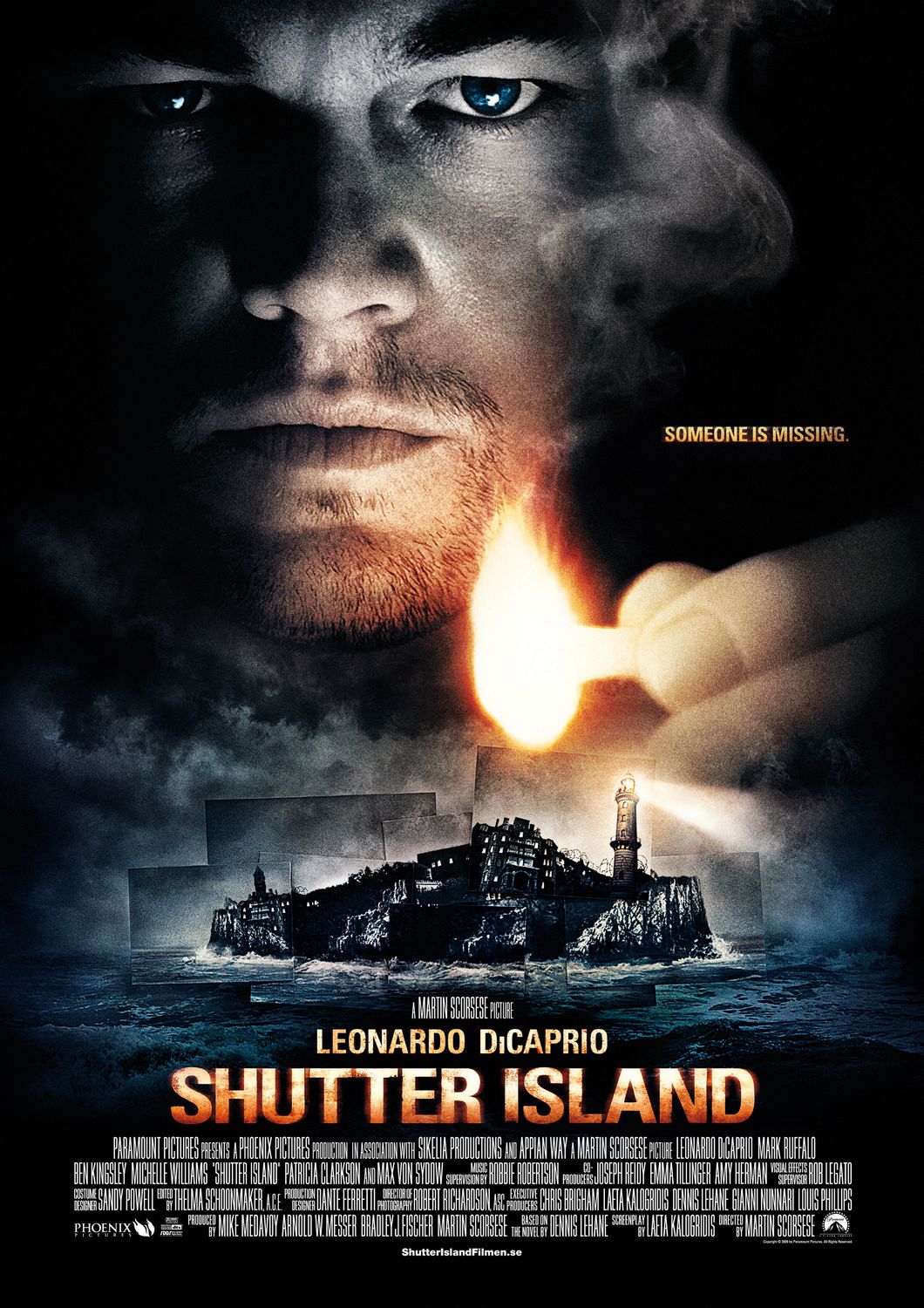
Shutter Island is a 2010 American neo-noir mystery psychological thriller film directed by Martin Scorsese, based on Dennis Lehane's 2003 novel of the same name. Leonardo DiCaprio stars as U.S. Marshal Edward "Teddy" Daniels, who is investigating a psychiatric facility on Shutter Island after one of the patients goes missing.


The teaser opens with a lightning flash on a close-up of Teddy Daniels' face, which exposes his discomfort in sleep to the audience. As typical of a psychological thriller, we are positioned close to his head, implying that the main conflict will be the main character's perception of the mental institute and his own experience and existence. Opening the scene with non-diegetic, grand orchestral crescendos imply the coming pace of the trailer. 

The orchestral piece is temporariliy silenced for a voice over saying: "Gentlemen, welcome to Shutter Island". As the diegetic voice over says this, we immediately are pulled with a fast zoom and tracking shot towards the gate, then to a woman who looks completely disheveled, and ragged. The camera slows whilst passing her, making the action of commanding quiet even more poignant. The orchestral piece picks up again when a close up of a lady's feet appear, then a close-up of the woman. She is seen with short blonde hair, blue eyes and red lipstick, hugging the main character, so that the audience assume that she may be his wife. The tension here is ramped up by a repeat of the lightning coupled with diegetic thunder sounds.

Here, fast straight cuts are used to cut away from the action very quickly so that the audience can only get a glimpse into the mental institution. Diegetic sounds like Teddy's shout, the lighting of the candle and the prisoners are exaggerated over the non-diegetic track to emphasise the significance of those actions. The colour pallette in these 7 shots are repeated and alternated, one with dull fire oranges, whites and browns, the other with pale blues, greens and aged browns. The discodance within the orchestral piece swells into a forte, becoming increasingly louder, and therefore creating a tense, claustrophobic environment.

A single discordant horn can be heard over the woman's laughter, which intensifies the already bubbling tensio in the scene. The woman has black hair and an aged blue jumper, suggesting that she may be one of the patients. The fact that the characters there face and turn away from the camera is significant- suggests that there is a secret which is being withheld from outsiders- the only way to know it is when you become one of them. Teddy's curious face seen through an over-the-shoulder shot suggests that his deseperation to find the problem within Shutter island is innocent, also reflected in his white overals. this is further emphasised by the hand held movements of the next shot: a child's hand reaching outwards.

The non diegetic music builds to a interupted cadence, whilst the pace of the tracking shots increase immensely. Use of the tunnel and cliffside generate a parralel between the prisoner running away from the bottom right side of the camera, and teddy reaching towards the  bottom left side of the camera. The symbol of death is evident with the blonde woman fading away, whilst being manhandled by an escapee, thrown directly into the cage and into the centre of the audience's view point

The next four shots are seen in quick succession, The rising dolly shot of the stairs, the fire motif repeated from the last shot of the woman/girl and The repeat of the tunnel running are all symbolic of the chaotic sense of invasion of the mind, as well as ramping the tension to a climax, where the non-diegetic music is silenced with a reverse of the first shot: a lightning flash to black, which is very interesting, as the teaser become cyclical.

The ending title is the only title seen within th tailer. The last shot is also an establishing shot of the island, which fades to an inkblot using the same colours, which add a certain mystery to the end. Its also interesting to note that the final few seconds of the teaser are in silence, as if to fully trap the audience's interest and curiosity to the rest of the film.


0
Share
Newer Posts Older Posts Home

Labels Cloud

  • audience
  • Carl G Jung
  • character
  • conventions
  • critical theory
  • death stranding
  • deconstruction
  • director
  • evaluation
  • feedback
  • film poster
  • film ratings
  • filming
  • font
  • genre
  • hand
  • head
  • hideo kojima
  • i saw the devil
  • inspirations
  • institutions
  • James F. Iaccino
  • kim jee-woon
  • korean
  • location
  • mise-en-scene
  • moodboard
  • music
  • Narrative arc
  • neon
  • outfit
  • pitch
  • post-production
  • poster
  • pre-production
  • production
  • props
  • psychological horror
  • quentin tarantino
  • questionnaire
  • reflection
  • research
  • senem
  • shanette
  • Shutter Island
  • story
  • storyboard
  • subgenre
  • survey
  • Tate Taylor
  • teaser trailer
  • The Girl on the Train
  • the hateful eight
  • typography
  • video game
  • virginia
  • website

Blog Archive

  • ▼  2017 (16)
    • ▼  May (3)
      • Evaluation
      • Teaser Trailer Audience Analysis
      • Representation in Our Trailer
    • ►  March (2)
    • ►  February (3)
    • ►  January (8)
  • ►  2016 (31)
    • ►  December (3)
    • ►  November (7)
    • ►  October (15)
    • ►  September (6)
Powered by Blogger.

Popular Posts

  • Psychological Thrillers and Horrors Moodboard
    Psychological Horror   Psychological horror is a subgenre of horror fiction th...
  • Character/Archetypes of Psychological Thriller/Horror
    Natalie Portman as Nina Sayers Black Swan (2010) A “psychological thriller” is a thriller sub-genre that focuses on the unstable emotio...
  • Sound and Music in Psychological Horror
    In a Psychological thriller/Horror, sound, diegetic and non diegetic, is very important, as it is used mainly to increase tension or amplify...
  • Conventions of a Teaser Trailer
    TEASER TRAILER Teaser trailers are made with the intention to pique the audience's interest and gain hype before the release of the f...
  • Critical theory- Psychological Horror/Thriller
    Whilst looking for the aspects of our preferred genre, we found some critical theory based on Jungian Archetypes in Horror films by James...
  • Filming Schedule and Shot Lists
    Filming schedule: *Day 1: 11am-3pm (not waiting until dusk) - Virginia and Shanette were at Waterfront, then joined by seem at Greenwich ...
  • Narrative Arc Moodboard
    This is our initial Narrative Arc from our pitch. this outlines what we basically want to do , if our project was a full scale movie. H...
  • Teaser Trailer Audience Analysis
    Audience theory relates to how the audience respond to and interpret any given text. The media audiences can be defined in...
  • Representation in Our Trailer
    Media texts are all representations of reality, intentionally mediated so that they are perceived in a specific light intended by their pr...
  • Director Technique Inspirations
    DIRECTOR INSPIRATIONS Before filming, it was important for me to see what is expected of a trailer within the psychological horror/thri...
Copyright © 2015 SVS

Created By ThemeXpose | Distributed By Gooyaabi Templates